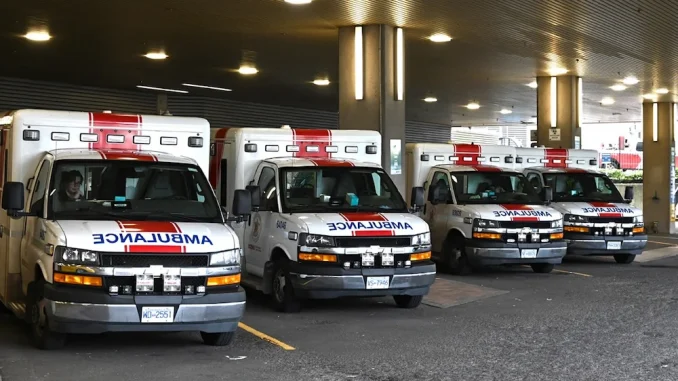
Overdose deaths are trending down, but BC is still in the thick of a crisis. Here’s what the data tells us.
by Michelle Gamage and The Tyee – click for the source article, and to support Canadian journalism
[Editor’s note: This article talks about overdose fatalities, including of youths, and the ongoing toxic drug crisis’s outsized impact on First Nations people.]
There were fewer drug poisonings, overdoses and fatalities in 2025, compared with 2024.
But British Columbia is still in the midst of a brutal unregulated toxic drug overdose crisis, according to recent updates from BC Emergency Health Services and the BC Coroners Service.
So far more than 19,053 British Columbians have been killed since early 2014, when unregulated fentanyl started showing up in the illicit drug supply. The province declared a public health emergency in April 2016 to address an unprecedented increase in deaths.
This April, that public health emergency will have been in place for a full decade.
“This emergency is much bigger than any of us can imagine — mass death on this scale is incomprehensible,” Karen Ward told The Tyee.
Ward is a tireless community advocate who tracks how government policy affects marginalized people across the province, with a focus on the Downtown Eastside.
“The numbers are down compared to last year, but these aren’t numbers, these are people, and it’s a new person dying every time,” she said.
Deaths will continue to rise until the government addresses the root problem, which is the unregulated drug supply, Ward told The Tyee.
“Are we going to let [this crisis] continue indefinitely? Because it won’t change by itself,” she said. “If we say we cannot — will not — let it continue, then we need to change what we’re doing, like adults. Or we can let it continue and it will just get more chaotic.”
Either way is a choice, and the government needs to own up to that, she said.
Ward is critical of the provincial government for framing the crisis as an “addiction” problem. If the problem is framed this way, then it can be “solved” by offering treatment, she said.
But it’s not that simple, Ward said.
The BC Coroners Service death review panel estimates there are 225,000 British Columbians who use unregulated drugs, many of them casual or infrequent users — government data estimates there are about 125,000 people living with opioid use disorder in B.C. and a further 26,000 or more with a stimulant use disorder.
“Highly toxic drugs are circulating in our communities, which means anyone — whether they’re using for the first time or have used regularly — faces the risk of death from poisoned drugs,” the B.C. Ministry of Health told The Tyee in an emailed statement.
There is no one solution to end this crisis, the statement continued, which is why the government is “urgently” building a “comprehensive system” of mental health and substance use care, “including harm reduction measures, early intervention and prevention, treatment and recovery, aftercare service, complex care housing and more.”
Deaths fell after BC’s decriminalization pilot
Deaths have been decreasing since their peak in 2023.
That’s the year B.C. introduced its decriminalization pilot project and the year when the province’s safer supply program was at its peak, Ward said.
Decriminalization ended on Jan. 31 and the safer supply program has been scaled back.
Ward said that could mean deaths will start to trend back up.
The Ministry of Health told The Tyee that “the decline in toxic drug deaths in B.C. and many jurisdictions in North America is likely due to a wide range of factors, including changes in the toxicity of the drug supply and increasing naloxone and treatment service availability.”
In 2024, the province distributed 498,028 injectable naloxone kits, it said.
The decrease in fatalities could also be due to a “decrease in median fentanyl concentrations in the illicit supply,” the ministry added.
However, there has been an increase in the presence of other contaminants, including benzodiazepines and tranquillizers such as medetomidine, as well as ongoing fluctuations in fentanyl analogues. This can cause other harms, such as non-fatal overdose and brain injury caused by a lack of blood flow to the brain, the ministry added.
According to the BC Coroners Service, fentanyl was detected in 77 per cent of all unregulated drug deaths in 2025 and carfentanil was detected in 98 deaths.
Fentanyl is 50 times more potent than heroin and 100 times more potent than morphine. The fentanyl analogue carfentanil, which has also increasingly been added to the unregulated supply, is 100 times more potent than fentanyl and 10,000 times more potent than morphine.
Because fentanyl is so potent, when it gets added to the unregulated supply it can be hard to judge what amount of drugs can be taken safely, and many people accidentally overdose because they didn’t realize they were taking drugs that were so potent they were toxic.
Ward said she has been asking the BC Coroners Service to collect and report more data, such as when an unregulated drug death occurred (which could show if people are dying in the middle of the night when harm reduction services are closed) and the ethno-racial cultural background of the dead (which could show what communities are not able to access harm reduction services), but she hasn’t seen that data.
She said she also wants the province to put more effort into analyzing its own data. For example, the BC Coroners Service’s unregulated drug toxicity deaths dashboard says that about 75 per cent of all fatalities are happening in a private or other residence.
“That means people dying alone or in isolation for the most part. Forty-five per cent in private residence and the rest in motels, hotels and social housing. We should be digging into those numbers more,” she said.
Ward would also like the government to report regularly on how many people are accessing the provincial safer supply program, how many treatment beds are full and what the wait times are, and how Indigenous people — especially youth — are being harmed by the unregulated drug supply.
The impact of the toxic drug crisis on First Nations people
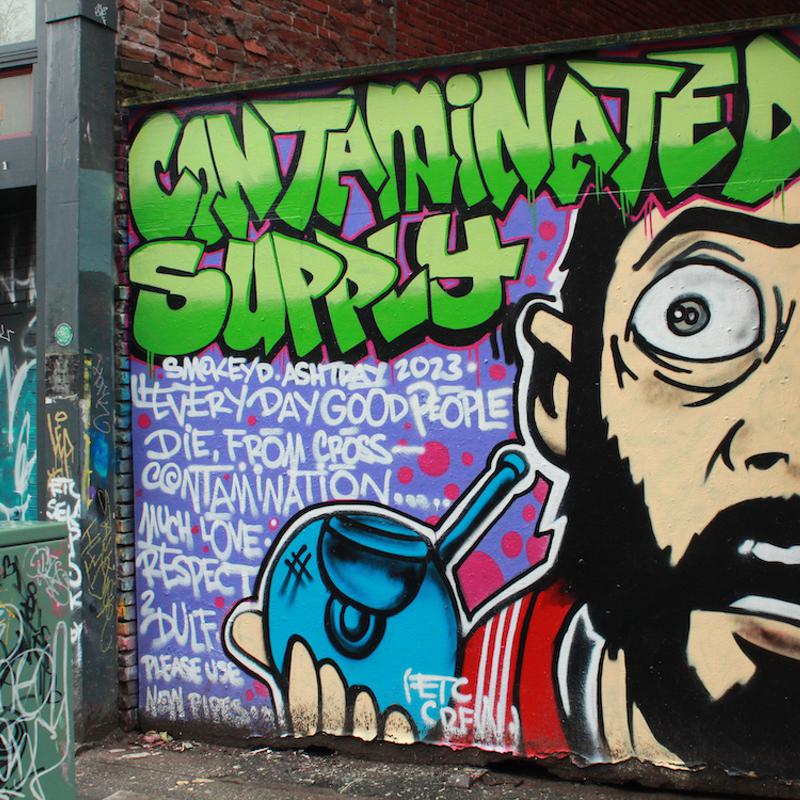
The First Nations Health Authority occasionally reports on the outsized impact the crisis is having on First Nations across the province. From January to June 2025, 143 First Nations people died from toxic drug poisonings. During the same period in 2024, 233 First Nations people died from toxic drug poisonings.
From 2021 to 2024, First Nations youths aged 15 to 29 experienced more than 4,000 toxic drug poisoning events and 343 deaths.
First Nations people make up 3.4 per cent of B.C.’s population but made up almost 16 per cent of all toxic drug deaths in the first half of 2025, according to the First Nations Health Authority.
People currently or previously working in trades, in transport or as equipment operators are also being affected by the unregulated toxic drug supply. In 2022 they made up 21 per cent of unregulated drug deaths in B.C., which rose to 23 per cent of all fatalities in 2025, according to data reported by the BC Coroners Service.
How the crisis shows up in 911 call volume
The unregulated drug supply is affecting first responders too.
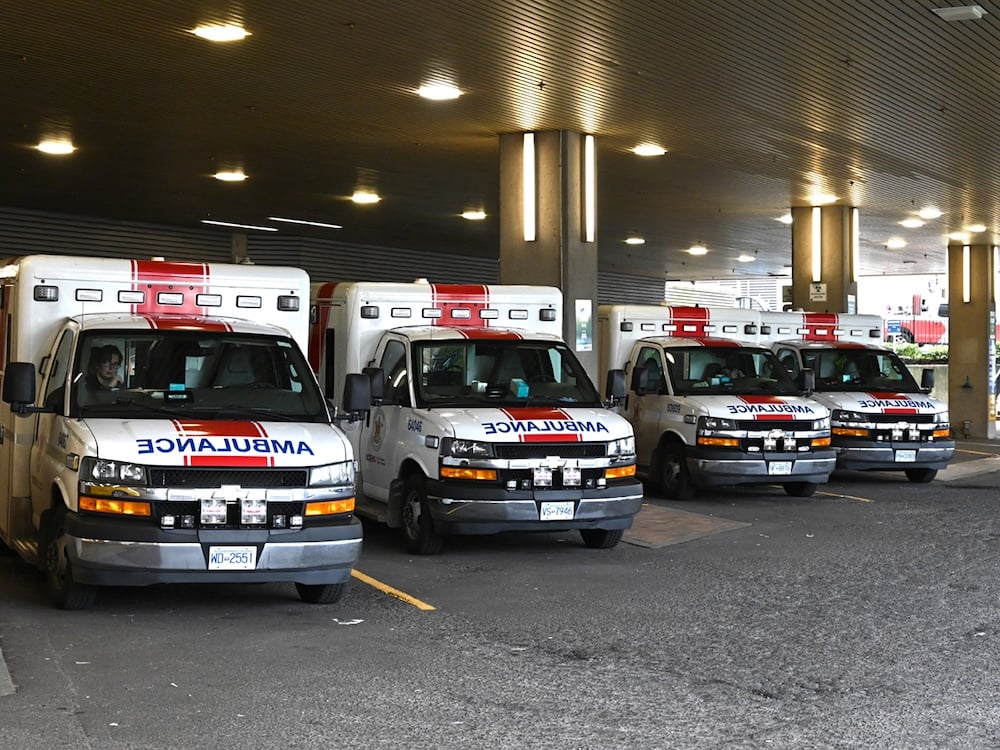
Since the public health emergency was declared in 2016, paramedics have seen a 105 per cent increase in how many overdose/poisoning calls they get annually, according to BC Emergency Health Services.
Last year BCEHS paramedics responded to 39,592 overdose/poisoning events, for a daily average of 108 calls per day.
In the same year, there were 1,826 unregulated drug deaths, with an unregulated drug death rate of 32 per 100,000 people, according to the BC Coroners Service.
For the last decade, BC Emergency Health Services has been reporting how many overdose/poisoning events paramedics respond to per year in communities across the province.
There were 21 communities across the province where paramedics responded to more than 500 overdoses/poisonings in a single month.
This can be pretty closely compared with data on unregulated drug deaths from the BC Coroners Service. However, it’s not a perfect comparison because the paramedic data is based on cities and the coroners data is based on local health area of injury. Local health areas pretty closely match up with municipal boundaries but may extend slightly beyond.
Large cities like Vancouver and Surrey have a large number of unregulated drug deaths, in part because they have large populations.
A better way to compare unregulated drug deaths across communities is per capita, or unregulated drug deaths per 100,000.
There are two ways to do this with publicly available data.
The BC Coroners Service reports unregulated drug deaths per 100,000 but breaks Vancouver down into six areas.
Presenting the data like this highlights the outsized impact the unregulated drug crisis is having on the Downtown Eastside, a small neighbourhood densely populated with low-income housing and social services.
However, it’s not the only way to look at the data. When the annual unregulated death toll is divided by the entire city’s population and then multiplied by 100,000, Vancouver doesn’t stand out from the rest of the province in per capita fatalities.
This chart doesn’t examine how 2022, 2023 and 2024 were more deadly years than 2021.
The Tyee calculated unregulated drug deaths for 2016 and 2021, because those are the years Vancouver’s official population was reported in the census.
Small communities can be hard hit by the crisis, especially when they aren’t able to offer accessible health care or harm reduction services, Ward said.
The Ministry of Health said that from January 2019 to October 2025, harm reduction and treatment interventions, including free take-home naloxone kits, witnessed consumption sites and opioid agonist treatment, are estimated to have prevented 49,500 toxic drug events, of which more than 78 per cent were potentially fatal events. ![[Tyee]](https://thetyee.ca/design-article.thetyee.ca/ui/img/yellowblob.png)
Leave a Reply
You must be logged in to post a comment.