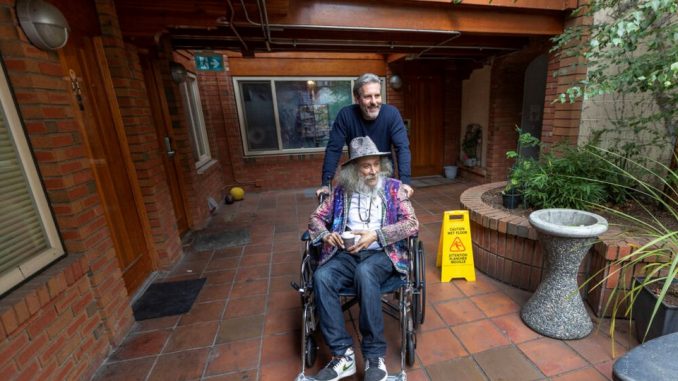
Some live in shelters, but they weren’t created — or funded — to meet the needs of an aging population.
- by Jody Paterson from Times Colonist –

Jennifer Lewis never imagined that at 60, she’d be living on so little money that she’d be fasting as a strategy for reducing food costs.
She gets all the benefits and subsidies an impoverished woman of 60 can qualify for in B.C., but she’s still paying 80 per cent of her income on rent.
Her physical health has deteriorated to the point that she’s been cleared for MAID if she wants it. With the death of her beloved service dog this summer adding deep grief to her life, that’s appealing, she says.
It’s not like there’s any relief in sight: Her income will drop even more when she turns 65 and switches from provincial to federal benefits.
Mario and Crystal, ages 67 and 61, have lived together in the same supportive housing building for the last five years. They’re hanging in as best they can as their health and mobility issues become increasingly challenging, but nothing about supportive housing was built with seniors in mind.
Mario falls at least three times a week now. With supportive housing staff not trained in helping older adults get up, some have been instructed to call 911 for falls rather than risk a WorkSafeBC violation, or ask another tenant to do the lifting. “I never realized how much of an inconvenience it is getting old,” says Mario.

Nancy, 71, thanks her lucky stars every day that she is paying less than $800 a month for a great apartment. But her landlady is in her late 80s, and Nancy can’t stop thinking about what might happen when the older woman dies.
Nancy has been on the waitlist for subsidized housing for two years now. The knowledge that she’ll have to take what she gets when the day comes that she finally gets the call fills her with dread. Anyone who refuses two offers from B.C. Housing has their application cancelled and has to begin the process all over again.
Trevor, 71, has been tenting at Oaklands Park for the last couple of weeks after seven years of sleeping on a friend’s couch. His last home had been in the Plaza Hotel, but it burned down in 2019. He was homeless for a month and then on his friend’s couch after that, until his friend asked that the arrangement wrap up.
“He gave me plenty of notice, but I just can’t find anything I can afford,” says Trevor. “At least it isn’t winter yet. It’s a challenge for me, but I’ll get through it.”
The spectre of seniors ending up homeless has been a talking point for many years in B.C. The end of legal discrimination against hiring workers past age 65 in B.C. came about 18 years ago largely in response to growing concern about poverty in old age.
But it’s well beyond a talking point now, say those who live and work on the front lines of the housing crisis.
With rents now higher than a person’s entire cheque if they’re dependent on provincial or federal benefits, even low-income seniors who have worked their entire lives are facing homelessness.
Recent counts of people living homeless in B.C. have found that not only is a quarter of all those surveyed over age 55, almost half of that group became homeless for the first time after becoming a senior.
Meanwhile, people growing old after lives of chronic homelessness are aging into services that were never intended for them. Services for people living homeless in B.C. aren’t required to be accessible, and neither the facilities nor the staff are prepared or trained to handle the many needs of people experiencing the accelerated aging common among anyone experiencing chronic homelessness.
Shelters and supportive housing were never envisioned as care homes, says Avery Taylor, manager of Victoria operations for PHS Community Services Society. But with no other options for people, that’s what is happening.
“We’re seeing people who are incontinent, people with dementia. That’s not something we can manage at a shelter or in congregated housing,” says Taylor. “There’s a real lack of care for seniors overall. People end up in hospital with no place to go back to, and the hospital calls around to the shelters to discharge them.
“But we don’t have care aides. We don’t have the kind of home support a senior needs. Our staff isn’t trained for this.”

‘Housing of last resort’
B.C.’s Office of the Seniors Advocate has been sounding the alarm about increasing poverty among seniors for at least a decade.
In 2017, then-advocate Isobel Mackenzie was in the news to make the point that while rents had risen 45 per cent in the previous 10 years, the rent ceiling on B.C.’s housing subsidy for seniors — Shelter Aid for Elderly Renters, known as SAFER — had gone up a mere nine per cent.
In those years, that meant that anyone paying above the SAFER rent ceiling of $750 a month was out of luck in terms of getting a larger subsidy. These days, the ceiling has been increased to $1,120, but average rent for a one-bedroom apartment in B.C. is still twice that much.
Some 15 per cent of B.C. seniors over age 65 live in poverty, three times the national average. More than a third of single senior women in the province live in poverty, the highest rate of any age group.
“Currently, 45 per cent of seniors in British Columbia are living on less than minimum wage, and 25 per cent of seniors are living on less than $21,000 a year,” Mackenzie said in 2022, when her office published B.C. Seniors: Falling Further Behind.
That report is in the process of being updated, with no expectation of a reversal in seniors’ falling fortunes.
A major risk for seniors who find themselves unhoused in an unprecedented housing crisis is simply not knowing how hard it’s going to be to find any housing that they can afford now that their circumstances have changed, says the office.
It might be divorce, declining health, a renoviction or any number of other unforeseen challenges that leave a senior looking for new housing. Someone who has been out of the housing hunt for many years typically has no idea just how difficult it’s going to be to find a new place they can afford. People from a generation unfamiliar with technology struggle with online systems for everything.
“You can’t just circle the ads in the classifieds anymore,” says one senior, who is now homeless on Pandora with her partner, after their landlord paid them $4,000 to leave their 20-year tenancy. “I thought all these organizations out here would help me find a place, but they just told me to check craigslist.”
Over in White Rock, Kelli-Rae Clark managed to cover her September rent with a loan from the B.C. Rent Bank, though she’s expected to start paying it back at $70 a month by October. But with October coming up fast — and November and December and all the months after — she has no idea how she’ll manage.
Laid up by a workplace accident last year, she got WorkSafeBC compensation for a short period. But there was an overpayment, and it happened right during the time of her annual assessment for the Guaranteed Income Supplement. Her GIS was cut by $900 a month — an error she’s appealing, but with no rent money in the meantime.
“I’ve been on the waitlist with B.C. Housing for 25 years. I got one offer, but it was in the Downtown Eastside with no kitchen, so I said no,” says Clark. “Now, I’m injured and I can’t work, and I’m really scared. It’s literally one day at a time right now.”
Lewis ran the gamut of options for people falling out of housing, including staying with friends, transition housing and a series of problematic landlords. Now, she just wants an end to the struggle.
“This has been a slow slide. I left my husband and managed with couch-surfing, camping and housesits for a while, but I’ve been living in this precarious way for four years now,” she says. “I’m not on the street, and I don’t use substances, but the physical toll of this is too much.”
Co-op housing ought to be a useful option for low-income seniors, notes Nancy.
But the minimum income needed to land a spot in co-op housing these days is typically around $30,000 — twice as high as Nancy’s income. Even a senior receiving maximum federal benefits at age 65 would still fall well short of that $30,000 minimum.
One of the bits of paid work that Nancy hangs onto is helping to manage rentals for a three-bedroom house in Vic West that allows pets, and whose owners have made a deliberate choice to keep the rent reasonable. That work has become a grim experience of bearing witness to people’s desperation, she says.
“I interviewed 10 of the 50 applicants, and have never seen that level of desperation in my life,” Nancy says. “It was awful to see how badly people needed a house like that.”
Micheal Vonn, CEO of PHS Community Services Society, says her organization is hearing from a growing number of seniors who once would never have been shopping for housing possibilities at street-serving agencies like PHS.
“They’re looking for housing of last resort,” says Vonn. “For us, this is a very new space and place. We’re not only challenged to bring seniors into our system, we’re not funded for it.”
Seniors should typically flow into more intensive forms of care as their needs increase, notes Vonn. That doesn’t seem to happen for people who end up in shelters and supportive housing.
Local street physician Dr. Jill Wiwcharuk says even getting an assessment of someone’s cognitive health is a major challenge given that many health professionals refuse to do that work in shelters and supportive housing.
“Long-term care, assisted living, palliative care — we do not see the populations we serve flowing into these channels,” says Vonn. “We are finding ourselves needing incontinence supplies, mobility aids, nutritional supplements. People can’t toilet. People can’t walk.
“We are not designed to have 71-year-olds with cognitive problems and incontinence living in our shelters. We don’t have the ability to prepare food for people with major dental issues, no teeth, all the various health needs. We’re trying to meet so many kinds of deeply complex social challenges, and we need to be resourced to do it.”
Shelters a poor fit for aging people
Shelters and supportive housing are intended as B.C.’s “last-ditch” housing solutions for people experiencing homelessness.
They’re neither built nor staffed to care for seniors. Their typically rough-and-ready environments set up for people with substance use disorders would likely be a deeply unsettling experience for any senior who had no previous experience of homelessness.
They’re also overwhelmed. B.C.’s 15,789 units of supportive housing already can’t meet the needs of the tens of thousands of people living homeless in the province, let alone an emerging population of seniors falling out of their housing.
Shelter beds in Victoria are already so scarce that beds are frequently full up by noon on any given day. And with no requirement that facilities be accessible, they’re a poor fit anyway for aging people who can’t climb into bunks, get themselves down onto a floor mat, or make their way up and down stairs.
(B.C. Housing is required to follow the Accessible British Columbia Act introduced in 2021, but only in terms of developing a plan for accessibility and a public feedback process.)
Yet the depth of the housing crisis — and provincial and federal benefits that have not kept up — has left shelters and supportive/transitional housing as the only option for anyone who falls out of housing.
“In the first year of COVID, it was shocking to everyone how many new, elderly people were coming into the system, wide-eyed and totally overwhelmed, with no street smarts and no clue of this other world,” says Wiwcharuk, who was working in Ontario at the time.
“Oftentimes, the reason they have lost their housing is cognitive change. It would have been happening for a while, but maybe they’ve been isolated and no one has seen the ball getting dropped. They’ve been flying under the radar — they can ‘pass.’ Until they can’t. Then they forget to pay the rent, or the utilities, and that becomes the reason for eviction.”
Seniors with personal experience of homelessness can end up with cognitive issues as well, which adds another complexity to their already complex lives. Aging bodies break down — and at a much earlier age when a person has a history of chronic homelessness.
“I work right in the heart of Pandora, and I see so many elderly people on the streets,” says Calland, a casual on Island Health’s Integrated Case Management Team. “Quite frequently, they’re using substances. We really need some sort of place to support our elderly.”
Supporting illicit drug use among seniors in long-term care is not an issue that most long-term care providers are eager to dive into. Waits for a long-term care bed are already well over a year in Greater Victoria at the best of times, and few accept anyone still in active drug use.
Island Health’s 320-bed facility, The Summit, is a rare exception, with a small unit that accommodates residents in active substance use.
But Solid Outreach shelter operator Randall Brazeau points out that it would be hard to find any senior who isn’t using some kind of medication. If long-term care facilities have staff who aren’t trained to manage people who use illicit substances, “then maybe the Health Care Aide certificate needs to be brought up to date,” he says.

As for the path from supportive housing to long-term care, there isn’t one.
“Hillside Terrace is a good example,” says Lauren Spears, who manages Hillside and two other seniors’ housing facilities operated by Victoria Cool Aid Society. “It’s an assisted living facility, but a lot of people there actually need long-term care. But long-term care is not prepared for these people.”
Spears cringes to think of seniors living homeless while facing all the challenges of aging. “Can you imagine having to change your Depends in a public washroom?” she asks.
She recalls seeing the number of aging homeless people tracking up even 10 years ago when she was working at Cool Aid’s Rock Bay shelter. These days, all five of Cool Aid’s seniors’ housing facilities are full up with referrals from Island Health, and staff routinely field cold calls from people who don’t fit Cool Aid’s mandate but are desperate for anywhere to live.
“People have the impression that seniors facing homelessness are isolated people without family,” says Spears. “Nope. I’ve got lots of people with loving families, but they can’t afford to help either.
“We see people on a $1,500 fixed income. People who worked hard but never saved up much, and now they’re injured and can’t work. People who were in hospital and lost their housing. People who shouldn’t be on their own all the time. People who made lots of money back in the day and couldn’t have imagined being in the situation they’re in now.”
University of Victoria professor Denise Cloutier saw how older women were concerned about safety in her recent study testing the use of peer navigators for older women and gender-diverse people at risk of homelessness.
“It was obvious that people in the study navigated the system so differently, thinking much more about personal safety,” says Cloutier. “Why can’t we do a better job of placing people where they have a chance of doing well?”
People living in the chaos of homelessness can face a particularly dire transition at age 65, when provincial benefits end and federal benefits begin. The process for getting on federal benefits can take up to a year, says Vonn, during which time the person may have no income.
As well, applicants require various government documents to prove who they are — not the kind of thing a person living homeless typically has on hand, and that has to be sorted out first.
PHS will “go to the ends of the Earth” to maintain tenants in their housing during the long wait for them to have money to be able to pay rent again, says Vonn. “But it’s to our detriment. How much risk can any facility take on?”
Mario went through that very experience two years ago when he turned 65. Already living in supportive housing, he could have faced eviction when his provincial benefits ended. But the housing provider took a risk and let him stay. Mario paid back the 12 months of owed rent once his federal benefits finally kicked in.
‘One disaster away from the street’
What would a better system for high-risk homeless seniors look like? Probably a lot like an adapted version of long-term care for people with the most needs, says Vonn. But right now, that doesn’t exist.
“We’re raising these issues where we can, but the word in government is: ‘Work within your budgetary envelope,’ ” says Vonn.
“So — a growing need, but no expansion of tools. That is not good. I hope that there will be a renewed concern about what we’re seeing in the realm of deep poverty. This could be a whole lot of people in the future.”
Our Place Society is stepping up the work of their 55-Plus Club to reach more seniors who are on the edge of homelessness.

The club organizes diverse activities ranging from dance parties and Zumba classes to presentations at city hall about the stigma that low-income seniors face when trying to get health care.
“One woman in the club is a cancer survivor, developing dementia and not eating well. She has just kind of fallen out of care,” says Kristen Sanborn, the new social inclusion support worker for seniors at Our Place.
“Another fellow is now in hospital and probably not coming out. He was housed for 20 years but then decided he wanted an elevator, so he gave up his apartment and then couldn’t find housing. He was almost 80 and having to stay on shelter mats.”
Our Place isn’t well-adapted for seniors with major mobility issues and dementia, but “we’re doing our best,” says Leah Young, director of housing and the Our Place community centre.
The organization would like to provide more finance-related support as well, helping seniors transition from provincial to federal benefits while ensuring that their rent still gets paid. (Deductions that go straight to a landlord aren’t an option under the federal system.)
“It’s hard when people in supportive housing are ‘aging out,’ ” says Young. “There aren’t enough beds in higher levels of care, and the system doesn’t always choose our folks. There’s a lot of stigma, and people can’t find their fit.”
Brazeau, who runs the shelter that Solid Outreach Society has in the basement of St. John the Divine Church, is deeply troubled by the growing number of seniors he sees hoping for a mat at the shelter.
“People are essentially being left to die on the streets. You’ve got people getting blocked from shelters because they have incontinence. So they go to hospital, and end up discharged right to the street. I think about my grandma — can you imagine, one bad thing happens to you and you’re out on the street, and this is how things are going to go?”
As for the seniors at the edge of homelessness, they just want to know that they’ll have stable housing among friendly faces in a place that feels like home as they grow older.
CJ recently turned 60. She describes herself as “one disaster away from the street,” but is crossing her fingers that a random encounter with a stranger — who ended up offering her an apartment in exchange for caretaking services — will work out.
Bernie, 62, has lived in supportive housing in Victoria since 2018, and wants to stay put. He spends a lot of time in hospital these days, and it comforts him that staff know he’s got extra cat food and litter stashed in his apartment so they can tend to his cat while he’s gone.
“I’ve been asked if I want to move into 55-plus housing, but being at this place keeps me close to what I need,” he says. “I’ve got meals. There’s a clinic right here. The staff know me, and when they think I’m not looking well, they respond right away.”
Angie, 65 and homeless on and off Pandora for five years now, says she’ll settle for just about any option if it means she no longer has to urinate in the street and can finally get some sleep.
“I sometimes think about having to die out here,” she says. “I don’t want to think of the pain of death and me not even able to be inside.”
Leave a Reply
You must be logged in to post a comment.