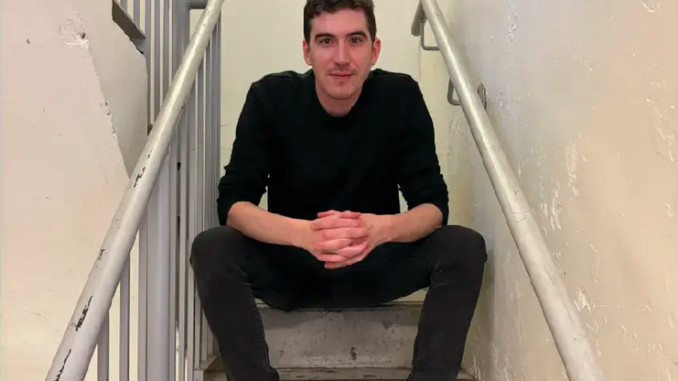
by Nathan Caddell from the Georgia Straight. The door to Molson Overdose Prevention Site (MOPS) at Main and Hastings opens up to an alleyway absolutely teeming with people. Some are loud, some are quiet. Most everyone in the vicinity greets Simon Goodspeed and John Nellany warmly as the pair shows me through the doorway.
Inside, things are moving quickly. Staff move about busily while people of all ages are getting treated at eight tables. One older woman, in the middle of treatment, sparks a conversation with me. Goodspeed makes small talk with a staff member as Nellany quickly and quietly moves a curtain in front of a woman who has exposed herself. On an average day, the Molson site will see around 100 visitors.
Upstairs is a crammed office space. The lights are dimmer. You can still hear most of what’s happening below. Pinned to the wall is a sheet of paper that tracks what day the provincial income assistance and disability benefit cheques are scheduled to come in each month. The facility changes its hours to be open 24/7 on weeks when the money arrives.
“Welcome to MOPS,” says Nellany as we sit down. Originally from Ireland and a restaurant manager before COVID hit, Nellany has been the project operations manager at MOPS for almost six years.
“The people that we support, the community that we look after, are some of the most incredible people,” Nellany says. “There are some tragic moments, I suppose, and some very difficult moments. But there are an awful lot of really great moments too, right? Fulfilling moments. I like to think that it evens out quite a bit.”
Goodspeed, senior manager at the PHS Community Services Society, which oversees MOPS and other overdose prevention and safe consumption sites, feels similarly.
“The community is really impressive and important, and it’s been quite an honour to be able to serve it,” Goodspeed says. “But also there are some very challenging and difficult experiences and things to witness. There’s a lack of comprehensive services. It’s so thinly spread out, despite this ongoing narrative amongst various commentators over the years that there’s been all this money that’s been thrown at the Downtown Eastside.”
Goodspeed is careful to not take aim specifically at different levels of government. But he reads the news.
Earlier this year, the provincial government opted not to continue its three-year drug decriminalization pilot plan after the political winds had shifted against the program.
The founders of the Drug User Liberation Front, who ran a compassion club distributing uncontaminated drugs to 47 people, were arrested in 2023 and found guilty in late 2025 of drug trafficking.
this emergency is becoming normalized – Simon Goodspeed
At the municipal level, Mayor Ken Sim and his ruling ABC Vancouver party took a strong stance against reopening the Thomus Donaghy Overdose Prevention Site in a new location at 900 Helmcken Street after the previous site on Howe Street in Yaletown shuttered in January.
In late May, the province announced that it would not be proceeding with reopening the Thomus Donaghy OPS via a statement from Minister of Health Josie Osborne. The statement cited “concerns from the city, local businesses, and community partners” as the reason for the decision. Mayor Ken Sim and ABC councillors celebrated the news.
“I am aware of the discourse and the way that this kind of issue has been framed, and I worry more about the way that this emergency that we find ourselves in is becoming normalized,” Goodspeed says. “Or that there are people deciding that they’re not really interested in doing much about it.”
In total, there are currently eight overdose prevention sites and safe injection sites in the city, most of which are a few blocks from each other in the Downtown Eastside.
But while government officials and many members of the public have seemingly thrown their hands up at the growing street disorder in the area, those on the ground like Nellany and Goodspeed warn that the problem with toxic street drugs is just getting worse. Restricting the supply further or taking away safe supply and drug-checking facilities could be catastrophic.
Numbers from the B.C. Coroners Service show 401 deaths in the province due to unregulated drugs between January and March 2026—a little lower than the 442 that happened in the same three months last year but well above pre-pandemic levels of 303 deaths in early 2019 or 279 in the first quarter of 2020. MOPS’ own numbers show a massive increase in overdoses, in large part due to an influx of drugs being cut with animal tranquilizers like medetomidine and xylazine.
“Over any 12-month period within the last two years, on average, our overdoses would be around 700. In the first four months of 2026 we’ve had 777,” Nellany says.
Naloxone can reverse opioid overdoses, but when substances are cut with other kinds of tranquilizers, it can result in critically lower blood pressure and dangerously slow heart rates that the medication can’t touch.
“They’re not using it on purpose—when the raw fentanyl product comes in, they’re finding it has medetomidine in it already,” Nellany says. “It seems to be a veterinary substance that you buy very cheaply on the black market, and it obviously has some sort of a sedation effect on people. It’s really not good.”
These substances are mostly new to Vancouver’s street drug supply, but Goodspeed notes that some American cities like Philadelphia saw an influx of medetomidine around 2023 and 2024.
“First, it was fentanyl being cut into heroin or whatever, and then it was, you know, after the fentanyl had sort of been there for a bit, benzodiazepines started being added
to the supply as a way of extending the high that people get from fentanyl,” Goodspeed says. “Part of the way out of it is that you have to have some form of regulated safe supply to remove the harms of medetomidine and xylazine, which makes your skin rot and causes all sorts of secondary health problems.”
Sim has spoken out against current harm reduction models and has implored the province to deliver mandatory care beds. Premier David Eby announced in 2024 that the province was expanding involuntary care, although advocates like the B.C. Division of the Canadian Mental Health Association say that the practice is at best unproven and at worst can increase rates of death after detained people are discharged.
Threatening to involuntarily detain people when there aren’t enough voluntary resources available for people at the scale and supply that’s needed, Goodspeed says, likely won’t change any outcomes.
“It’s disingenuous,” he says. “There are a network of factors that are influencing the way that these things exist, and they need to have wraparound supports. You need supervised consumption sites so that people see you from the beginning to the end, but you also need some form of regulated safe supply. The public health data is sound, insofar as the fact that these services work; they release drug-related harms. But it’s not one-size-fitsall; everyone is different.”
For Nellany, the challenges are obvious, but the job is also a reminder of where he came from.
“My dad said to me years ago, ‘If your mom and I passed away in a car accident, this neighbour would raise you, and that neighbour would raise your sisters,’ ” he recalls. “And I would say, ‘How do you know that?’ He’s like, ‘Because community.’ And the first time I’ve seen that outside the little town in Ireland where I’m from was in the Downtown Eastside on my first day here.”
Leave a Reply
You must be logged in to post a comment.