by Dustin Godfrey at Filter Magazine – read the source article here
February 18, 2026
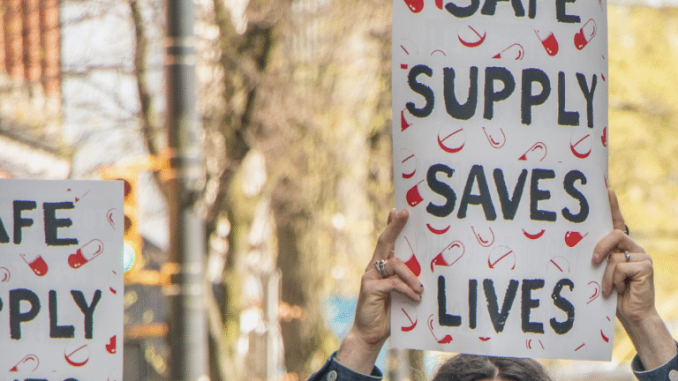
Even as British Columbia’s Ministry of Health was caving to right-wing panic over “diversion” of safe supply drugs, its public safety ministry internally acknowledged the negligible role of diverted opioids in the unregulated drug supply.
In February 2025, the provincial government announced that it would no longer allow new patients in its medicalized safer supply program to receive take-home doses, and would also transition existing patients away from take-homes.
“[W]e need to know that medications, like prescribed alternatives, are being used by the person they’re intended for,” said Health Minister Josie Osborne, in seeking to justify making harm reduction less accessible.
But that same month, BC’s Ministry of Public Safety and Solicitor General noted in budget preparation documents that hydromorphone—the opioid that makes up the vast majority of safe supply prescriptions—accounted for just 0.3 percent of drugs seized by the Vancouver Police Department (VPD) by weight in 2023.
Rather than publicize the evidence to correct loud claims of safe supply diversion flooding communities, the BC government opted to sit on the information.
The documents, publicly unavailable until summer 2025, were among dozens of records submitted as evidence in the trial of Drug User Liberation Front co-founders Jeremy Kalicum and Eris Nyx, who were convicted in November.
Rather than publicize the evidence early in 2025 to correct loud claims of safe supply diversion flooding communities, the BC government opted to sit on the information and retreat from safe supply as a policy.
Neither the Ministry of Health nor the Ministry of Public Safety and Solicitor General responded to Filter’s requests for comment by publication time.
“It’s shocking to me, the abrupt change in public policy without that information being publicly available,” Dr. Ryan Herriot, a family doctor, addiction medicine specialist and Doctors for Sensible Drug Policy co-founder, told Filter.
He called the 0.3 percent figure “lower even than I would have imagined.”
But even that figure may substantially overestimate the market presence of safe supply hydromorphone.
Herriot said it’s unclear if the VPD is distinguishing between actual hydromorphone pills and counterfeits. And the figure doesn’t distinguish between safe supply prescriptions and pain prescriptions—which, Herriot noted, make up the overwhelming majority of hydromorphone patients.
“It definitely speaks to policy being driven by electioneering, vote-mongering, as opposed to following the evidence.”
At its peak in March 2023, just 4,946 patients were prescribed opioids under BC’s prescribed safer supply program, according to BC Centre for Disease Control data. That number dropped to 4,212 by December that year, and continued to decline to 2,893 as of October 2025.
By comparison, the province’s 2024 Prescription Drug Atlas counts just under 99,500 patients receiving hydromorphone in 2023, not including prescriptions for hospital in-patients, or opioid agonist therapy or safe supply patients.
Herriot said the BC government’s move toward allowing only witnessed safe supply dosing amounts to “discourse-based policymaking as opposed to evidence-based policymaking.”
“It definitely speaks to policy being driven by electioneering, vote-mongering, that kind of thing, as opposed to following the evidence,” he said. “It also speaks to this kind of general unwillingness to defend their own policies when they’re perhaps viewed as controversial by some people.”
Rather than educating people on the program, Herriot added, the province left an information vacuum for others to fill with misleading narratives.
Since 2022, pushers of Canada’s moral panic over harm reduction policies have depicted safe-supply drugs flooding communities. In 2023, National Post writer Adam Zivo went so far as to claim, based entirely on anecdotes, that safe-supply diversion was “fueling a new opioid crisis.”
That claim gained traction in early 2024, when two small cities’ Royal Canadian Mounted Police detachments mentioned safe supply in press releases about drug busts.
While the police didn’t indicate whether or how they differentiated between genuine hydromorphone and counterfeits, or between safe-supply and other hydromorphone prescriptions, the media largely parroted their talking points.
The diversion that does happen, Herriot noted, is overwhelmingly among peers. “It’s probably best characterized as a form of mutual aid.”
The narrative advanced further a year later, when a leaked BC Ministry of Health presentation referenced a “significant portion” of safe supply being diverted and trafficked, both nationally and internationally. As Herriot pointed out, there doesn’t appear to have been any definition of what counted as “significant.”
The diversion that does happen, Herriot noted, is overwhelmingly among peers—that is, one person with a prescription sharing with someone they personally know.
“It’s probably best characterized as a form of mutual aid,” he said. “There’s very little evidence—in fact, none I’m aware of—of harm being caused to anyone, first of all; and secondly, of this phenomenon of ‘contagion.’ There’s no evidence that people are to a significant degree selling or passing on tablets to opioid-naive individuals.”
Counter to Zivo’s claims of a “new opioid crisis,” BC Centre on Disease Control statistics have shown declining rates of new opioid use disorders among almost all age groups over nearly a decade, with particularly pronounced declines among those aged 19–34.
“A policy response should be proportionate to the scale of the problem, and … we just don’t really have good evidence that there is a significant problem,” Herriot said.
Top officials in the BC government had attempted for a moment to push back on the moral panic, with provincial health officer Dr. Bonnie Henry calling in February 2024 for safe supply to be expanded beyond a medical model.
But the governing BC NDP, an ostensibly center-left party, quickly caved to the pressure around diversion after the Ministry of Health presentation leaked in early 2025—making its anti-safe supply move despite the evidence we now know it had.
That was part of a series of regressions the party made from harm reduction, with the province also backing away from its decriminalization pilot project, curbing low-barrier access to basic harm reduction supplies and cutting funding for the Drug User Liberation Front.
DULF co-founders Kalicum and Nyx are currently pursuing a legal challengeto the constitutionality of their charges.
Leave a Reply
You must be logged in to post a comment.