What B.C. Actually Provides for People Living With Substance Use Disorders and why.
by RON MERK – Read the source article at his Learning Moments Substack – FEB 02, 2026
Public conversations about substance use in British Columbia are often charged with emotion, misunderstanding, and frustration. One of the most common beliefs is the idea that “the government is giving out free drugs.” It’s a phrase that spreads easily on social media, partly because it’s simple and partly because it confirms the bias that many already fear or assume. But as with most complex issues, the truth isn’t captured in a slogan, and in this case, it’s filled with misinformation.
This Learning Moment is meant to slow down the conversation and give people an accurate understanding of what British Columbia actually provides when it comes to medication for substance use disorders, particularly opioid use disorder. This is not an opinion piece. It’s a factual explanation, written in plain language, meant to help us all think more clearly about a complicated public-health system.
As of 2025, B.C. has two very different categories of medications that relate to substance use:
· Treatment medications for opioid use disorder.
· Safer supply or “prescribed alternatives,” which are highly specialized, tightly regulated prescriptions.
These terms often get mixed together online, which creates confusion. But the differences between them matter. They shape how people receive care, how medications are accessed, and what supports are available. Let’s walk through each one clearly.
Let’s Address “Free” First
It is important to understand why these medications are covered through Plan Z, the Province’s universal coverage plan, meaning “full coverage” for eligible B.C. residents under the PharmaCare program. The goal is not to reward drug use, but to save lives, reduce harm and control/reduce costs for the Province.
B.C. has faced a toxic drug crisis for years, with overdose deaths skyrocketing, and the province has declared it a public health emergency since 2016. Providing free, evidence-based medications ensures that people at the highest risk have access to treatments that stabilize their health, reduce the likelihood of overdose, and create an opportunity to engage in longer-term recovery. It also reduces emergency visits, first response calls and a host of other costs that would occur if meds were not universally available.
A similar approach is used for tobacco substance use. Nicotine patches are provided free through PharmaCare. In this context, when a health condition is found to impact significant numbers of people, free access is a life-saving public health measure, and a cost control initiative – not a giveaway.
1. Treatment Medications: What Most People Receive
The foundation of care for opioid use disorder in British Columbia is something called Opioid Agonist Treatment (OAT). These medications are evidence-based, internationally recognized, and considered the gold standard for treating opioid addiction (British Columbia Ministry of Health, 2025).
OAT medications don’t create a high in people who are dependent on opioids. Instead, they stabilize the brain, reduce withdrawal symptoms, lower cravings, and make it possible for people to regain control of their lives. They’re treatment medications, not “free drugs.”
As of 2025, B.C. covers several OAT medications under PharmaCare:
Methadone
PharmaCare covers common forms of methadone, including Methadose and Metadol-D. Methadone reduces cravings and withdrawal symptoms and helps people function without the rollercoaster of illicit opioid use (Government of British Columbia, 2025a).
Buprenorphine/naloxone (generic)
Often known by the brand name Suboxone, this medication is fully covered in its generic forms and partially covered for the brand version. It’s considered a first-line treatment because it’s safe and effective, and many people prefer it because it can, under certain conditions, be taken at home (Government of British Columbia, 2025a).
Slow-release oral morphine (Kadian)
For people who don’t respond well to methadone or buprenorphine, slow-release oral morphine can be an option. It’s long-acting and helps stabilize withdrawal symptoms throughout the day (Government of British Columbia, 2025a).
Long-acting injectable buprenorphine (Sublocade)
This is a monthly injection that offers steady, sustained treatment. For people who struggle with daily dosing or pharmacy attendance, this can be life-changing (Government of British Columbia, 2025a).
Special Authority, explained simply
Some forms or doses require something called Special Authority, which is just a process where the prescriber asks PharmaCare for approval. This applies mainly to brand-name versions or specialized doses that aren’t normally covered. Most people never need Special Authority, but it’s available when necessary.
Coverage across B.C.
Coverage for these treatment medications applies province-wide. But availability of prescribers can vary. Larger centres like Vancouver, Victoria, and Kelowna have more clinics and pharmacies offering OAT. In some rural and northern communities, the options may be more limited, and people may have to rely on whichever form of OAT is accessible locally.
It’s important to understand:
These medications are not optional “extras.” They’re medically necessary treatments for a chronic condition. And the evidence is clear: when people receive OAT, deaths go down, health improves, and stability increases.
2. Safer Supply or “Prescribed Alternatives”: What It Actually Is
The second category is something called prescribed alternatives or, more commonly, safer supply. This is where much of the public confusion arises.
Safer supply is not the same thing as treatment.
· It’s not OAT.
· And it’s not offered to everyone.
As of 2025, safer supply in B.C. is specialized, limited, and highly regulated(Government of British Columbia, 2025b).
Here’s what safer supply actually means:
A narrow tool for a specific group
Safer supply prescriptions are intended for people who are at very high risk of poisoning from B.C.’s toxic illicit drug supply and who haven’t been successful or stable on traditional treatment alone.
These are people who are often deeply entrenched in street drug markets, have repeated overdoses, or use substances that don’t have an OAT equivalent—like illicit stimulants.
Who prescribes it?
Only certain physicians and nurse practitioners prescribe safer supply, and the number is small. Most clinicians in B.C. do not prescribe safer supply at all.
What’s prescribed?
Prescribed alternatives can include pharmaceutical versions of opioids or stimulants. Examples may include hydromorphone tablets or methylphenidate, depending on the clinical need (Government of British Columbia, 2025b).
These are not open-ended prescriptions. They’re carefully monitored, regularly reviewed, and adjusted to reduce harm—not to produce intoxication.
Witnessed dosing is common
Many safer supply prescriptions are witnessed, meaning the person must take the medication at a pharmacy or clinic where staff observe the dose. This prevents diversion and ensures the medication is used as intended.
Take-home doses, when they happen, are controlled. Some people, after demonstrating stability and adherence, may receive limited take-home doses, but this is far from automatic. It’s based on clinical judgment, risk assessment, and pharmacy capacity.
Regional differences
Urban centres like Vancouver have more prescribers participating in safer supply models. Rural and northern communities may have none at all. This is sometimes misunderstood as “expansion,” when the reality is that access is uneven and limited.
What Safer Supply Is Not
A clear explanation is worth repeating:
Safer supply is not a program where people are handed “free drugs.”
· It’s not accessible to everyone who uses drugs.
· It’s not meant to replace treatment medications.
· It’s not an easy prescription for physicians to provide.
· It’s not a casual walk-in service.
· It does not resemble the sensationalized images shared online.
Safer supply exists for one key reason: the illicit drug supply in B.C. is the most toxic in Canada, and people are dying at unprecedented rates. Prescribed alternatives aim to keep people alive long enough for treatment and recovery to become possible.
This is harm reduction in its most literal sense.
3. Witnessed Dosing: Why and When It’s Used
Whether a person is receiving treatment medication or a prescribed alternative, many medications in this field involve witnessed dosing.
Witnessed dosing means the medication is taken at a pharmacy or clinic under observation. It’s not a punishment. It’s a measure of safety—for the person and for the community.
Why it matters for treatment
In the early stages of OAT, witnessed dosing helps stabilize people, prevents misuse, and ensures the dose is effective. As stability increases, people may earn take-home doses, often called “carries.”
Why it matters for safer supply
Witnessed dosing prevents diversion, ensures the person is actually receiving the medication, and helps the prescriber monitor effectiveness and risks.
In both cases, it’s a tool that supports safety and gradual independence.
4. Why These Distinctions Matter
When people believe that “B.C. gives out free drugs,” it reduces a complex, carefully regulated system into a misleading headline. That misunderstanding fuels stigma. It discourages people from seeking help. And it erodes public trust in health systems that are trying—imperfectly—to respond to a crisis.
· Clear information helps us all.
· Treatment medications help people regain stability.
· Prescribed alternatives prevent deaths.
· Witnessed dosing supports safety.
· And none of this resembles the exaggerated claims circulating online.
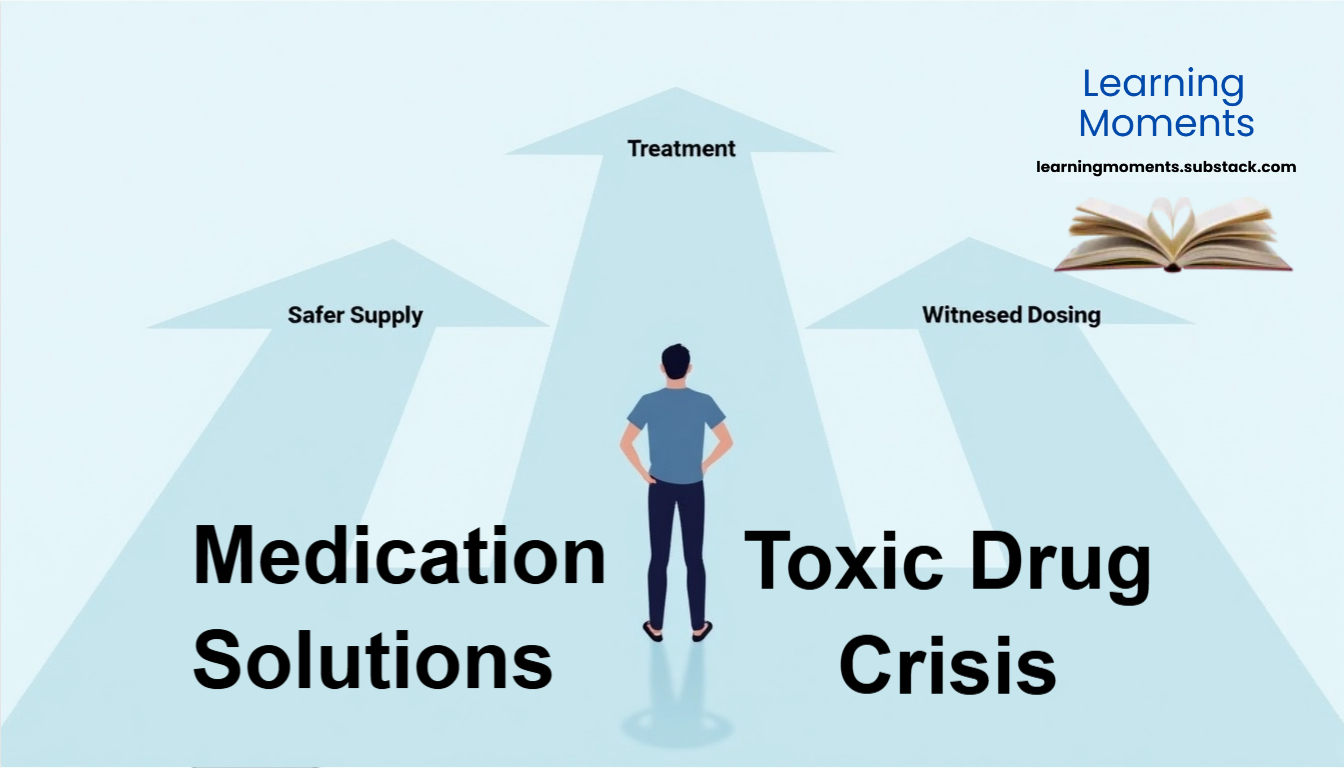
Understanding the difference between treatment, safer supply, and witnessed dosing allows us to have more honest conversations about what B.C. is actually doing—and what people living with substance use disorders actually need.
References (APA Style, “as of 2025”)
British Columbia Ministry of Health. (2025). Drug coverage for opioid use disorder. Government of British Columbia. https://www2.gov.bc.ca/gov/content/health/health-drug-coverage/pharmacare-for-bc-residents/what-we-cover/drug-coverage-opioid-use-disorder
Government of British Columbia. (2025a). Opioid agonist treatment product identification numbers (PINs and DINs). https://www2.gov.bc.ca/gov/content/health/practitioner-professional-resources/pharmacare/pharmacies/product-identification-numbers/oat-pins-and-dins
Government of British Columbia. (2025b). Prescribed alternatives and pharmaceutical options for people at risk of toxic drug poisoning. https://www2.gov.bc.ca/gov/content/health/health-drug-coverage/pharmacare-for-bc-residents/what-we-cover/drug-coverage-opioid-use-disorder
Government of British Columbia. (2025c). PharmaCare plans and coverage information. https://www2.gov.bc.ca/gov/content/health/practitioner-professional-resources/pharmacare/plans
Thanks for reading Learning Moments! This
Leave a Reply
You must be logged in to post a comment.