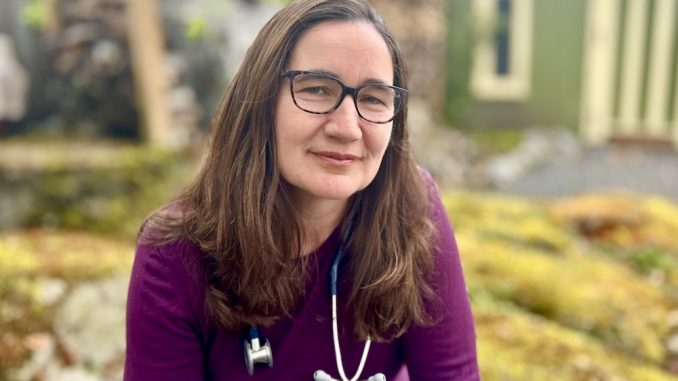
If elected officials won’t heed experts, the outreach physician says, maybe they’ll listen to her 100,000 followers. – From The Tyee – read the source article here
“What does someone who is unhoused and sleeping outside do all day?” Dr. Jill Wiwcharuk asks in an Instagram video, standing in front of a fence in a lacquer-red raincoat.
“I’ve never been homeless myself, so I’m not a true expert in this, but I’m tired of hearing my patients be called lazy, because when you’re homeless, you simply don’t have that luxury,” she continues.
Wiwcharuk goes on to explain what a real day might look like for an unhoused person in a video that has drawn nearly three million views and 200,000 likes on Instagram. For the 51-year-old street medicine doctor based in Victoria, B.C., this kind of reach has become ordinary since she started posting on Instagram last December.
The other videos she’s uploaded to her page, which is aptly named @streetdrjill, have also drawn views at speed. Their thumbnails say things like “Homeless with a pet,” “Addiction is not a choice” and “What is the fentanyl fold?” Her comments are flooded with both shows of support and changing minds.
Five months in, with 100,000 followers across Instagram, Facebook and YouTube, the clinician turned content creator is just getting used to life as an internet star.
As a street doctor of 15 years, Wiwcharuk has seen how devastating public misconceptions around addiction and homelessness can be.
Her main objective in posting educational content is to foster compassion, she explains over Zoom. She makes her Instagram videos “off the side of her desk” with her husband.
Wiwcharuk remembers one patient who was mistreated at an emergency department. Unfortunately, she adds, this is a common occurrence for the people she works with.
“He told me: ‘If people knew what I have been through in my life, they would never treat me like this,’” she says.
The profound misjudgment at the root of the man’s pain became a guiding principle for Wiwcharuk’s work. If she can help people to understand “the reasons why some folks are in the situations they’re in, the suffering they’re constantly undergoing,” systemic change would surely follow.
In the solar system of Wiwcharuk’s work, compassion is the sun around which everything revolves.
“I believe deeply that people are generally good, and when given the right evidence and stories, we’re built to be compassionate,” she explains.
Unfortunately, burgeoning moral panic and loud voices calling for rollback on support for people facing addiction and homelessness have created intolerance and judgment “in our whole political climate,” says Wiwcharuk.
Before she studied medicine, Wiwcharuk was drawn to the arts. Her first degrees were a bachelor of arts and a bachelor of music from the University of Victoria, where she studied violin.
“I did my undergrads with no thought whatsoever about medicine,” she says. That was, until a few years later when she was living and volunteering with children who had leprosy in a small village north of Kolkata. When a devastating earthquake hit the opposite side of India, Wiwcharuk wanted to respond to calls for aid, but thought: “What am I gonna do, rush over there and teach people violin?”
When she returned to Canada, she enrolled as a medical student at McMaster University in Hamilton, Ontario, and immediately felt called to street medicine, which she practised in one of her clinical rotations. She lived in Hamilton for 11 years before moving back to her home province of B.C. in 2022.
“I was partly escaping a right-wing government that was making it harder and harder for me to do a good job of being an addictions doctor,” she says of the move. “And I had high hopes for coming to B.C. to a left-wing, NDP government with a premier who was a human rights lawyer and had worked on the Downtown Eastside.”
In some ways, relocation allowed Wiwcharuk to do the kind of work she wanted to do. When she was working in Hamilton, her outreach clinic was a one-person operation — just Wiwcharuk, a three-legged stool, a medical kit and her cellphone.
Today, she runs an outreach van that functions as a full mobile clinic with a team of nurses. This progress is thanks to the harm reduction workers who show up each day, she says.
“When I was younger, I had more faith in our elected officials,” she says. Her assessment now is different: it appears that evidence, research and expert voices aren’t worth as much to elected officials as the currency of public opinion.
It was a communications strategist at Doctors for Safer Drug Policy, an organization Wiwcharuk works with, who gave her the idea to start a social media account. If it was public opinion that would influence public policy, then it was public opinion that needed to be addressed.
At first, being on social media was way out of Wiwcharuk’s comfort zone. Before she started @streetdrjill, she says, her main interaction with social media was telling her kids to “get the hell off it.”
For Wiwcharuk, the numbers game is irrelevant. She keeps posting because of the feedback she receives. The most meaningful moments emerge when people change their minds after watching one of her videos.
She recalls one direct message from a follower whose sister suffered from opioid addiction. Wiwcharuk’s video, which reframed addiction as trying to stay out of withdrawal as opposed to trying to stay on drugs, spurred a “paradigm shift” for the woman. She thanked Wiwcharuk for helping her mend her strained relationship with her sister.
Another follower left a comment on one of Wiwcharuk’s videos saying that her thoughtful content gave them the courage to ask an unhoused person who seemed to be in distress if they were OK, instead of just walking by.
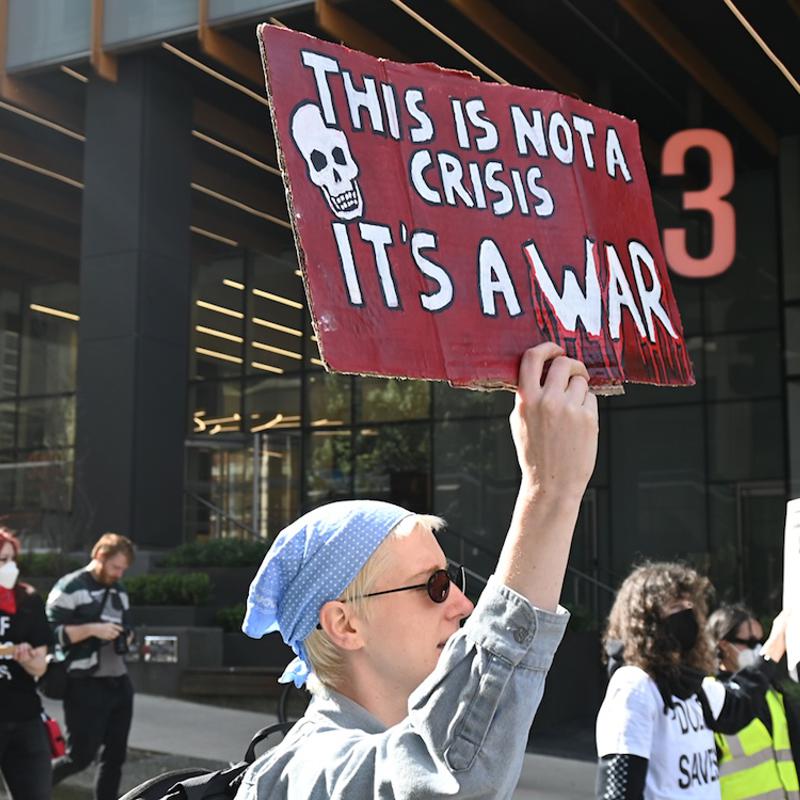
BC’s Toxic Drug Crisis Hits a Grim 10-Year Anniversary
This work is advocacy, just like the rest of medicine, Wiwcharuk says. Some days, being an advocate looks like calling a medical imaging office from the outreach van and requesting an appointment on the spot, so she can tell an unhoused patient — who may not have a phone or a primary care physician — when and where to show up for an ultrasound while they’re still with her.
Other days, it looks like scripting, recording and posting an Instagram reel myth-busting methadone. Wiwcharuk hopes that in doing so, she’s fostering compassion, and that compassion in turn will effect a shift in public opinion towards protecting life-saving public health measures such as harm reduction, decriminalization, support for people who are unhoused, and an understanding that policing is not the solution to the toxic drug crisis.
As furious as it once made her that elected officials seemed unconcerned with evidence from experts, Wiwcharuk now finds hope in the power of public opinion to influence politics.
In the meantime, collective and individual action are crucial to keeping up the good fight, she says.
As for what exactly people can do, Wiwcharuk smiles: “We’re actually about to make a couple reels on that.” ![[Tyee]](https://thetyee.ca/design-article.thetyee.ca/ui/img/yellowblob.png)
Leave a Reply
You must be logged in to post a comment.