Ten years after a declaration of a state of emergency around the toxic drug crisis, it continues to kill more people every month than died in an entire year when heroin dominated the market.
by Jody Paterson @ Times Colonist – read the source article here


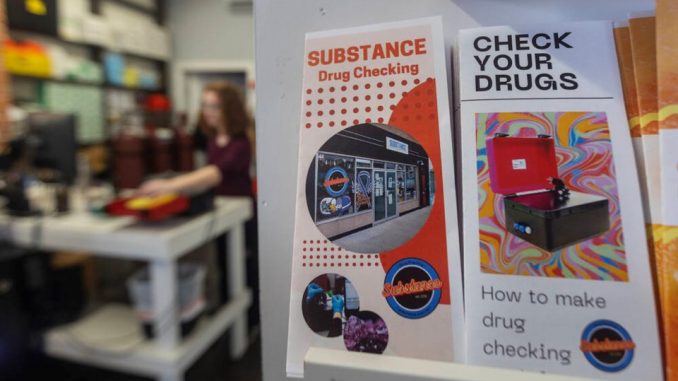
Katy Booth with medetomidine rapid drug test kit at Substance Drug Checking on Cook Street. The version of the heavily sedating veterinary tranquillizer that’s showing up locally was never tested on humans or intended for human use. DARREN STONE, TIMES COLONIST
Late afternoon on a winter-cold sidewalk outside the shelter at Rock Bay Landing, where the subject has turned to heroin.
“Oh, man, heroin!” laments Jessica after hearing the guy standing next to her talking about the years when it was the only opioid on the street. “I miss it. Heroin was like a warm hug, nothing like the stuff that’s out here now.”
Her friend nods in agreement: “On a cold night, heroin would warm you right up for the whole night.”
Those days are long gone. People buying “down” nowadays get maybe 90 minutes of impact from a dose before they need to find more.
It’s all fentanyl, sedatives and animal tranquillizers now, ever-changing and extremely toxic. Withdrawal is brutal, trapping people in a never-ending cycle of having to use again and again, to keep the dreaded sickness at bay.
“Nobody is getting high anymore, they’re just running from the sickness,” says an outreach worker on the 900-block of Pandora. “You just can’t get dope-sick if you’re living out here. Every cell of your being will be screaming, and that was with heroin. Fentanyl is so much worse. The benzos? Even worse.”
Withdrawal from benzos can take weeks and can be life-threatening. The heavy animal tranquillizers showing up in the supply in recent months are a new kind of hell. People drop where they stand, and endure frightening hallucinations and psychosis.
“The fillings in your teeth fall out. Your teeth fall out. Your mouth is constantly dried up. It’s all so different now,” says Jessica.

The ever-changing chemical soup that makes up the modern “down” supply in B.C. is prepared by shadowy chemists using dark-web recipe books in clandestine labs in Canada and around the world. Finding any heroin in it these days is a rarity.
The impact of that shift on the lives of British Columbians is frighteningly clear. Ten years into a declaration of a state of emergency around the toxic drug crisis, the crisis has killed more than 18,000 people in the province, and continues to kill more people every month than died in an entire year back when heroin dominated the market.
Whatever might be said about those days and that drug, people at least mostly knew how not to overdose back when heroin dominated the down scene. A single dose lasted for several hours. Even those with major dependencies could stay functional enough to attend to all the other aspects of life — like work, or making it to an appointment.
The pharmacology was stable and familiar after 100-plus years of use. The medical community knew how to treat people’s dependency and withdrawal symptoms and understood the secondary health conditions associated with heroin’s regular use. They knew the dose needed to move a person from heroin to a more socially acceptable opioid medication like methadone.
That’s all over now.
First came the rise of synthetic opioids like oxycodone about 20 years ago, when pharmaceutical companies were actively soliciting doctors to up their opioid prescribing. Then came an even bigger game-changer — fentanyl, an anesthetic from the late 1960s repurposed in the 1990s as a drug for cancer patients experiencing severe pain. It began showing up in B.C.’s illicit supply in the early 2010s.

Accidental overdoses soared as people were exposed to a drug that they initially didn’t even know they were taking, let alone had any tolerance to. Anywhere from 20 to 50 times stronger than heroin, fentanyl’s dangerous potency brought mass death.
Then came the benzodiazepines — no-name versions of sedatives like Xanax, Ativan and Valium. Added to extend the effects of the fentanyl, they grew into a significant problem on their own, both for the dependencies they led to and their notorious and miserable withdrawal experiences.
Much more recently, the local supply has changed again. The heavily sedating veterinary tranquillizer medetomidine is new in the mix. The version showing up locally was never tested on humans or intended for human use. It knocks people out for hours and can cause psychosis and hallucinations. An overdose from down containing medetomidine is much harder to reverse with naloxone.
“An opioid withdrawal, even in the old days, was really awful, but now it’s this multiplicity of drugs,” says local street doctor and addiction medicine specialist Dr. Jill Wiwcharuk. “People who have never had a seizure are having them when they’re coming off opioids. That’s not something that we’ve ever seen before.
“People are coming into the emergency room with a constellation of symptoms we’re not used to seeing, both in the context of withdrawal and side effects. There are so many different things in what people are using now.”
It’s not just the users and the health-care system that are noticing a change. Ann Livingston, a long-time organizer of drug-user groups in B.C., says involving opioid users in community activism or at peer-led consumption sites has been much harder since the sedatives and tranquillizers started showing up in the down supply.
“Everyone is passed out now!” says Livingston. “In Nanaimo, we have an organizing thing going on that’s entirely made up of stimulant users, because the opioid users are all passed out.”
A nimble and profitable industry
The intent of prohibition and enforcement around street drugs in Canada has always been to shut the industry down. Instead, what it inadvertently created is a nimble and profitable multinational industry that would be the envy of any Forbes 500 company, were it not for the products it sells.
The illicit-drug industry is innovative, largely invisible and completely unregulated. It’s adept at functioning in a high-risk, high-return work environment. It adapts quickly to any barrier placed in its way. When lawmakers move to restrict a particular ingredient, the industry simply finds a replacement.
“The more things are criminalized, the harder it is to keep up with the changes to the supply,” says Katy Booth, project co-ordinator for Substance, the University of Victoria’s drug-checking research program. “The criminalization of alcohol was overturned 100 years ago. If we’d done the same for substances, maybe we wouldn’t be in this crisis right now.”
Fentanyl initially came into the local down supply as an enhancement to attract customers, says a source who worked in the industry years back. He recalls spreading out a newly arrived shipment of heroin and misting it with fentanyl to give it more oomph. Fentanyl soon had its own fans, he says.
The North America-wide jump in opioid prescribing had already happened by then. Those years introduced opioids to many new users, some of whom ended up turning to the street supply once their doctors decided they were going through too many pills.
Meanwhile, global forces were affecting the industry. The 2001 terrorist attack on the World Trade Center Twin Towers changed U.S.-Canada border practices, and a cottage industry of smugglers on both sides of the border soon found themselves working under multinational criminal entities, says this source.
Mexican and South American cartels that once contracted with Americans and Canadians to bring opioids and cocaine north wanted greater control over the industry’s multi-layered supply chain. They established a direct presence in both countries.
At the government level, policymakers and politicians were doubling down on prohibition and enforcement throughout this time. Specific “precursors” used to make synthetic drugs were identified and criminalized.

Farmers growing poppies — the source of morphine, the organic compound needed for heroin production — were either encouraged to grow other crops or criminalized. (The Taliban outlawed poppy cultivation in Afghanistan in 2022).
The industry responded by finding new ingredients that hadn’t yet been restricted, says Booth. More and more tongue-twisting names began showing up in UVic’s weekly drug-testing reports. The benzodiazepines, added to fentanyl to give it “legs” and make the high last longer: Bromazolam, desalkylgidazepam, flubromazapam. The animal tranquillizers: Xylazine, medetomidine.
The shift from heroin to fentanyl was good for sellers and their profit margins, but devastating for opioid users. They began dying in astounding numbers starting around 2014 in Canada, as fentanyl became the dominant opioid in an uncontrolled, unregulated industry. They are still dying, 150 or more every month in B.C. alone.
People living homeless make up just 12 per cent of the deaths, but since December, at least eight people living homeless have died from overdoses on downtown streets.
“The pandemic marked a major turning point,” says Booth. “In the years leading up to COVID, your heroin had fentanyl in it. After COVID, your fentanyl had heroin in it.”
In 2010, before the arrival of fentanyl, accidental overdose deaths in B.C. totalled 211 for the entire province. At the peak of the fentanyl crisis in 2023, that was roughly the number of deaths each month.
Death totals fell in 2024 and again in 2025, but there were still 1,826 deaths in B.C. last year. That’s six times as many people in B.C. who are killed in motor vehicle accidents in any given year.
Psychosis common in stimulant users
Other types of illicit drugs haven’t yet become the toxic soup of the opioid supply. Samples of stimulants like cocaine and crystal methamphetamine, known as “side” on the street, are still turning up largely as billed in drug-checking, says Booth.
“We don’t see a lot of crack, but when we do, it’s crack,” she adds.
But that’s not to suggest that a stimulant user is safe from harm in the current drug environment. As long as the street supply is unregulated, it’s still very much like going to the liquor store for a half-sack of beer with no clue about what will be in the bottle, or even if one bottle will be the same as another, says Wiwcharuk.
For a stimulant user with no tolerance for fentanyl, the slightest trace can be deadly.
“I’ve had a number of patients who were not using opioids, but used a pipe that had been used for fentanyl. That bit of residue in the pipe was enough to lead to a fatal overdose,” says Wiwcharuk.

A poisoned drug supply can kill, but people living homeless can suffer other repercussions. Some develop massive leg ulcers, says Wiwcharuk, and lose limbs from endless infections that they can’t get on top of in the unsanitary and damp conditions of the street.
Their spines can end up permanently deformed. The heavy sedation of the down leaves them twisted into terrible positions for hours, causing severe nerve damage and disability.
People living homeless are malnourished and never get enough sleep. Those using needles are at risk of infections that settle in their vertebrae, says Wiwcharuk.
Many ought to be in hospital, but that would mean leaving everything they own to be confiscated by bylaw officers, and risking agonizing withdrawal symptoms while waiting in the emergency department. Being judged, shamed and turned away as “drug-seeking” by emergency staff is another reality.
“People are so sick, but they still won’t go,” says an outreach worker who had to bribe one fellow with three packs of cigarettes just to get his badly infected skin condition treated.
Substance-induced psychosis is very common in stimulant users, adds Wiwcharuk, as are lower-leg wounds caused by constricted blood vessels and poor circulation. Xylazine can lead to severe leg ulcers that fester for months. Crystal methamphetamine can bring on prolonged psychosis that leaves users extremely vulnerable and frightens the people around them, says Booth.
The tolerance that regular substance users have developed is astounding, says Wiwcharuk. One slow-release patch of fentanyl could kill a non-opioid user, but someone who uses fentanyl all the time might need 12 or more patches just to hold withdrawal symptoms at bay.
That fact complicates the highly politicized conversation around transitioning people onto prescription-grade drugs, as drugs frequently have to be prescribed at doses far above the “norm.”

Down on Pandora Avenue, Tyler knows all about that problem. Back when he was in Grade 2, he was started on 10 milligrams a day of Dexedrine for his ADHD. Years later, when he was a young adult and went back to the doctor to restart his prescription, the doctor put him on 10 milligrams a day, just like in Grade 2.
Pretty soon, he was using four pills a day, and the doctor was cutting him off. After that, it was on to crystal methamphetamine — a chemical cousin to Dexedrine — and then homelessness.
“There are people down here who do drugs because they’re homeless, and people who are homeless because they do drugs,” says Tyler. “Lots of people get cut off their prescription and end up down here.”
The amount that people living homeless spend on drugs varies depending on how much money they have. One down user says he could spend $50 to $100 a day if he had it, but could tough it out on $10 in a pinch, although he’d be extremely sick for the entire day.
“The withdrawal a person experiences nowadays if they ever go cold turkey is entirely different than in the heroin days,” says Wiwcharuk.
“When you’re in opioid withdrawal, you’ve got an impending sense of total hopelessness. You’ve got uncontrollable diarrhea. You can’t sit down. You’re feeling pain everywhere, especially at any site of an old injury. You’re sweating, you’re yawning — and that’s just the opioids. There will be benzo withdrawal as well, and you can die from that, because you can get into a seizure that just doesn’t stop.”
All signs point to stepped-up enforcement
Where is this crisis leading? Many countries around the world are doing things differently to move people away from toxic drugs and a criminalized environment.
But all signs at the political level in B.C. point toward stepped-up enforcement, with little tolerance either politically or publicly for an understanding of street-level drug use as a coping mechanism best managed as a health issue.
Politicians are now using “community safety” as code-speak for cracking down even harder. The idea of forced drug treatment has surfaced again, despite decades of research questioning its effectiveness, and the well-documented risk of increased overdose when people leave treatment and relapse.
Possessing any amount of illicit drugs is illegal again since an exemption for possession of 2.5 grams ended in January.
In such a charged environment, a single moment of moral panic can change everything. An example: B.C.’s 2020 introduction of a program to shift people with opioid use disorder to a prescribed supply of narcotics to get them away from the erratic and dangerous street supply.

Fewer than 5,000 of an estimated 100,000 people with the disorder in B.C. had been enrolled in that program in 2023 when a then-Conservative party member claimed that a young woman had reportedly died from fentanyl diverted from “safe supply” into the criminal market.
The anecdote was never proven, and even if true, it was one death from a prescribed drug in a sea of ongoing deaths caused by unregulated drugs. Nonetheless, the New Democrat government responded by rapidly putting the brakes on the program.
The dwindling number of people still enrolled in it are now required to take each and every dose of their medication in front of a health professional. It’s an impossible ask for people facing multiple daily trips somewhere just to access their medication. The expectation is that most will return to the street supply.
“If there was political will, less stigma, a strong medical response — yes, it is fully possible to substitute different drugs to help people get away from unregulated drugs. We could do something about this crisis,” says Wiwcharuk. “But the biggest thing that needs to change in any of this is to see what’s going on as a medical issue, not a criminal one.”
How strong are different opioids?
Synthetic opioid strengths as compared to morphine, the organic component found in opium poppies:
• Oxycodone — 1.5 times stronger
• Heroin — 2 to 5 times stronger
• Hydromorphone — 4 to 5 times stronger
• Methadone — 5 to 10 times stronger
• Fentanyl — 100 times stronger
• Fluorofentanyl — 100 to 200 times stronger, not approved for human use
• Carfentanil — 10,000 times stronger, not approved for human use
Leave a Reply
You must be logged in to post a comment.